Monday, May 23, 2011

OKC vs. Dallas


This Oklahoma City Thunder versus Dallas Mavericks series has been very interesting to watch. Both teams have proven that they can score, rebound, and play excellent defense. Plus, the intensity level has been obsolete through five games.

In Game five, it's looking like the Thunder are setting themselves up to even the series at 2-2. With 3:14 left in the fourth quarter, Oklahoma is up, 99 to 91. However, Dallas is trying hard to claw back despite never leading in the game.

Dirk Nowitzki has 37 points for the Mavericks and he just hit two ridiculous fade-away jumpers to close the Thunder lead to three, 101 to 98. Shawn Marion just hit one of two free throws with 38.6 seconds left to bring the score to 101 to 99.

Nowitzki has at least 10 points in the fourth quarter of every game this series, adding another 10 in game five. What this player is doing is legendary, folks. He's only missed two free throws during the series, too.

Nowitzki is heading to the line with 6.4 seconds left, down two points. Well, he iced both –– tie game at 101 to 101. Kevin Durant tries to put up a shot for the Thunder with two seconds left, but it's blocked and Jason Kidd makes a smart play for Dallas and calls timeout. The Mavericks have 0.7 seconds to win the game. Last shot is off the mark and this game is going to overtime.

The game should have never gone to overtime, but Oklahoma let down and allowed Dallas to slither right back into the contest.

The Mavericks grab its first lead of the game, 103 to 101, after Nowitzki makes two more free throws. A three by Russell Westbrook rims out for Oklahoma, and the score is 105 to 103, Dallas ahead. Serge Ibaka drains a jumper for the Thunder, tying the game at 105 to 105. The intensity I mentioned earlier is still there. I doubt it'll go anywhere. What a fun series.

Now, there's 1:05 left remaining in overtime. The ball should be in Durant's or Nowitzki's hands. After a Thunder turnover, Nowitzki fakes and kicks a pass out to Jason Kidd, who knocks down a huge three-pointer with 40.3 seconds left. Westbrook attacks the rim quickly, but the shot is no good. Oklahoma has to foul and hope for good luck, down 109 to 105 with 13 seconds left.

The Thunder faithful are stunned. You could probably hear a pin drop in the building. Some fans are heading to the exits? Durant tries a three, but misses. Dallas wins, 112 to 105.

Oklahoma have no one to blame but themselves for not closing the game out. With six minutes left, the Thunder led, 99 to 84. It looked like the team had control of the series, but then the wheels came off. This is unbelievable. Hats off to Dallas for never quitting.

Now, the Mavericks control the series, up 3-1, but don't count the Thunder out. The intensity of this series is way too high for that.

Wednesday, April 20, 2011

Young Widows: In and Out of Youth and Lightness


Young Widows isn't a band who stays in the same place for too long and this is clearly evident on In and Out of Youth and Lightness, its third proper full length and second with Temporary Residence. The band has hinted at dark mellowness in the past, for example 2008's "The Guitar" from Old Wounds, but now the dark doom is here to stay for an entire album's worth. Almost every Young Widows review of the past mentioned The Jesus Lizard and the influence is still there, maybe just a little bit. Check the sway of chords and twang of "In and Out of Lightness" for proof.

While analyzing Youth and Lightness, I found myself going back to Old Wounds, just to make sure that Young Widows is the same band. Well, they are and they aren't. Same individuals, but many things have changed; Evan Patterson has a Nick Cave like drawl, no more metal bashing, and only a few rousing moments ("Future Heart, "White Golden Rings). The rest is steady mood and intricate guitar work from Patterson, who has now solidified himself as the master of his own eerie domain. That's one thing that hasn't changed: Patterson's progression and range as a guitarist –– it's hair raising stuff. On "Right In the End," Patterson throws in some friendly acoustic Americana for the album's shortest track at three minutes. This band is from Louisville and recorded with Kevin Ratterman (My Morning Jacket) in an old funeral home.

At nine tracks and 48 minutes, Youth and Lightness is by far the longest Young Widows record to date. Six tracks go past five minutes, but this hypnotic music never gets boring in length. Patterson may get the most attention for his precise axe work, but Nick Thieneman (bass, backing vocals) and Jeremy McMonigle (drum kit, tambourine, sleigh bells, piano, anvil, triangle) provide a very steady and chunky rhythm section, coming through with perfect fills. "White Golden Rings" lets loose for a thunderous chorus, but still not up to older standards for the band. McMonigle starts final track "In and Out of Youth" with a piano, setting up for an atmospheric climax.

Patterson ends the album by saying, "These wild dreams are done." Maybe Young Widows left its spiraling wildness behind, growing into a more mature self. The dark, swaying mood proves that much. Past Young Widows fans, like myself, will find themselves waiting for that huge metallic explosion on Youth and Lightness, but it'll never come. When the band almost seems to loose its shit, the music plateaus, burning into a dark haze. Don't sleep on this one.

Monday, April 11, 2011

Pissed Jeans: Hope for Men


Oh man, my roommate loved Pissed Jeans. He kind of gave this ugly stare, disgusted. “It’s just a lot of noise,” he says. But that's why this band is so awesome. Now, on their second album, Hope for Men, the band has found its sound. The separation is superior, with most of Matt Korvette’s vocal, while moaned, sounding audible. The lyrics are worth picking up, like “Bad Wind”, a song about wind blowing through a town, wiping everything away. All the frenzied noise stops for “Scrapbooking,” giving Korvette time to struggle through old pictures. It’s quite haunting, piano and all.

Pissed Jeans is an ugly, hostile band and they throw drunk mêlées for shows (witnessed) that will leave you deaf for two days. Not in a bad way. “I’ve Still Got You (Ice Cream)” is a song about ice cream and how it makes problems seem easier. The band locks into grooves at many points, but none better than “Fantasy World,” rolling through hills of smog to get to this huge party room filled with booze and grape juice. The wall is completely torn down. I love the live sound of the record and also the added experimenting of “Scrapbooking” and “The Jogger,” which is all feedback while Korvette lists off stereotypes of people that make the “not so rich majority” of the world feel smaller.


Hope for Men is brilliant because the common working person can relate. I know I do. I like ice cream, beer, wind, pizza, and kicking the shit out of my drum set. Pissed Jeans makes taking out some stress a part-time job. I wonder how far they can take this.

M.I.A. "Kala"


There are a lot of questions about who M.I.A. is as a person (real name Mathangi), but no questions about her music. It just depends on how Maya would like to move you. Particularly, on her second album, Kala, those moves are all going in different directions. Take “20 Dollar,” which begins with the most atmospheric opening heard in a few years on record, only to keep the song lurching until crazy synths come through and wipe the floor clean. Maya samples “Where Is My Mind?” from the Pixies and I’m wondering, where the fuck is my mind? That’s the peak of the album.


It only takes a few tracks of Kala to make a clear point. This is some serious instrumentation; forget her political views. The real sparks glow on “Paper Planes,” a song featured in stoner-dude flick Pineapple Express. All Maya wants to do is get high and “take your money”, but being high does make this album a little better than it already is. Props to The Clash for letting her sample “Straight to Hell” –– wonder what they think about it.


“XR2” is a horn contest gone right, where everyone is a true winner. Half-baked agit-pop for sure –– like this magnificent album. Kala goes out with a cool burn with Timbland helping on the knobs for “Come Around.” Maya reminds us that “the beat goes on,” but you’ll wish that it never had to stop. M.I.A. has dealt with a lot of scrutiny, but she’s building some sort of musical revolution. We should all spin this record at once and, strangely march in circles.

Monday, January 3, 2011

Unwound: The Future of What


There are punk bands, and then there are punk bands that think outside the box. Unwound was the later, a band that pushed its ideas to an extreme, breaking any mold that was thought possible.
The Future of What, Unwound's third full length release (but really it's fourth album) for Kill Rock Stars is a blanket of tuneful noise. Most of the tracks stay around three minutes or less, except for a few epic curve balls ("Descension," Disappoint," and "Swan"). It's a record that can't be taken lightly.
Guitarist/vocalist Justin Trosper starts Future off by asking, "Where's your energy?" in "New Energy," a blast of a song that is pure jolt. Nothing goes quietly from there on out. Unwound is loud and full of steel, but wavers enough to keep the mind wandering. Even though Trosper and his infectious guitar deserve much attention, Sara Lund (drums) and Vern Rumsey (bass) carry the weight of all 13 songs.
The furious pace of Future slows a bit with "Re-Enact the Crime" and "Equally Stupid," which might be the best one-two punch of the album. You can actually hear the blues bleed out of each song. It's a welcome turn. The first side ends with "Descension," a floating island of drone that will infect goosebumps on the arms.
Unwound goes back to the punk blasts on the second side, three to be exact, until melting into more drone rhythms to close out Future. "Dissappoint" and "Swan" might leave you sunk into your couch, but how? Unwound had you pacing around the room just a few songs before. "Swan," an eight-minute closer, locks on to a breakneck choral coast that never seems to end.
Don't worry, you won't want it to.

Thursday, December 9, 2010

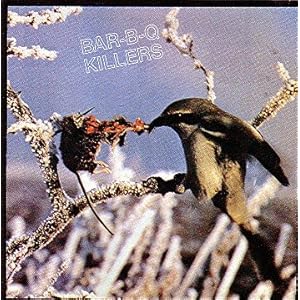
Bar-B-Q-Killers: Comely


Let's get one thing settled first: I bought this record a while ago just because of the band name. I was interested, but I don't know why. I was setting my ears up for failure and undoubtedly put a costly dent into my solid record collection.
Bar-B-Q-Killers, a band from Athens, Ga., released Comely in 1987 on Twilight Records. It was the only album they made, but why? They shouldn't have put this out because it's just not good. These 11 songs sound like Southern-fried shit.
David Judd (bass), Arthur Johnson (drums), Claire Horne (guitar), and Laura Carter (vocals, guitar) are trying way too hard. These songs sound forced and its a mess of a record. Carter sounds like she's about to lose her voice during every song, and since the band never put out another album, she probably did.
However, you must love the song titles: "Weird Shit," Dookie Tingue," "Jose O. Dingleberry," and "Her Shit on his Dick," which finally ends the racket. Even though Comely is distasteful, some songs can be tolerated. "Jose O. Dingleberry" starts the second side with a scuzzy hook, and "Fistula" drives a noisy path into, well no where.
I could throw this record away, but Bar-B-Q-Killers have one hell of a band name and an even worse attitude. I'll keep it for color.

Thursday, December 2, 2010

Sonic Youth: A Thousand Leaves


Despite being smack dab in the middle of all the hysteria, Sonic Youth never quite fit in with the grunge era. The band was too obsessed with angular noises to fit the criteria of the genre. Yes, Dirty had a grinding backbeat, but no, it was not grunge. Guitarists Thurston Moore and Lee Ranaldo were too experimental.
Sonic Youth went back to challenging territory with Washing Machine and it continued with A Thousand Leaves in 1998. Sexy and cool vocalist/bass player Kim Gordon starts the record off with a nice soft hush in "Contre le Sexisme" and that continues into "Sunday," one of the few real rockers on the double LP. Sonic Youth fills a lot of space over 74 minutes of Leaves, but there is nare a boring moment in sight. Ranaldo and Moore concentrate on quiet material most of the time, but it has a captivating warmth to it.
Fans might be astonished by the length of the record (three songs over nine minutes), but the music holds the attention. Moore and Ranaldo get into a guitar squall battle on "Karen Koltrane" and then Gordon comes in with some political rants on "The Ineffable Me," with Ranaldo and Moore noodling like it's their day job in the background.
A Thousand Leaves has the twists and turns of other Sonic Youth albums of the past, but the sounds are something completely new. It's a engaging listen that's worth the time.